
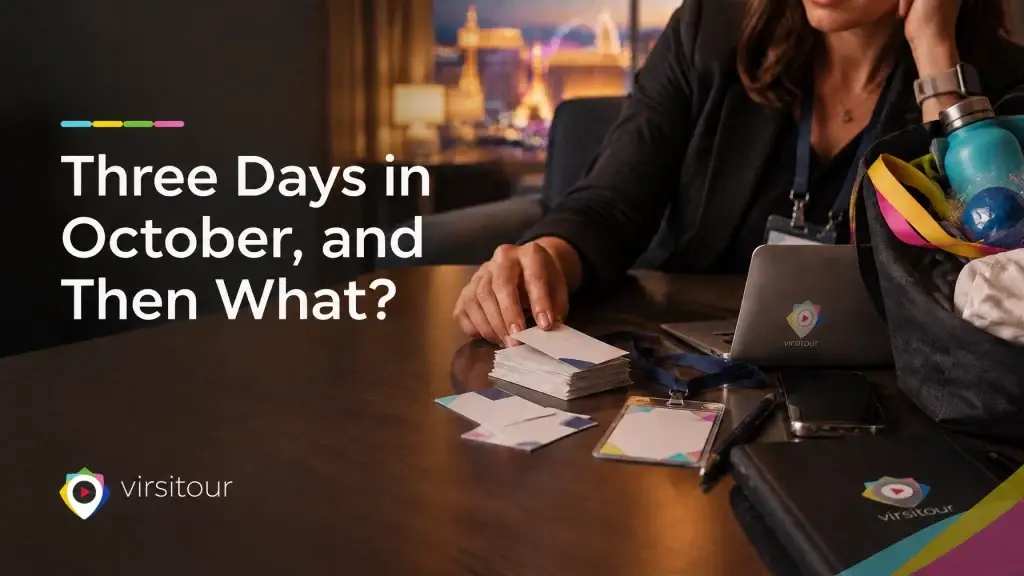
virsitour's founder did not attend IMEX America this year. After years of attending as a hosted buyer, this was the first year she chose to sit it out.
That decision is not a criticism of IMEX. In fact, it begins with genuine affection for what the show does well.
There is the energy of walking onto the show floor and immediately seeing people you know. There are the hugs, the quick reunions, and the conversations that begin with “How have you been?” after months of missed calls and full calendars.
There are also the destinations.
Memphis has been especially meaningful. At IMEX, the teams were able to solidify next steps for future business, exactly the kind of progress that can come from being in the same room. ALHI has also become a favorite connection. Every time the representative and Debbie meet, the conversation is thoughtful, familiar, and productive.
And then there is Club Ichi, a community that has shared more than professional introductions. Watching the Tropicana implode from the MGM Grand a few years ago was a once-in-a-lifetime moment, made more memorable because it was experienced together.
The hugs matter. The community matters. Even the swag has its moment.
“I get a lot of swag and a lot of hugs, and I like both,” says Debbie Garcia, CMP, founder of virsitour. “But I’m ready to stop packing it and bringing it home. A lot more swag and hugs, which I like, but not strategy.”
That is the honest turn.
When the math stopped working
IMEX is very good at putting thousands of people who need each other into one building for three days.
The 2025 edition, according to IMEX’s official statistics, brought together 17,683 participants, 3,700 exhibiting companies from more than 80 countries, and 6,145 buyers. More than 4,700 were hosted buyers, and the show generated 92,000 meetings across one-to-one appointments, group meetings, and presentations.
That scale is remarkable. It is also overwhelming.
For hosted buyers, the flight may be covered, but the calendar belongs to the appointment schedule. Some meetings are a genuine fit. Others are not. Often, both sides know within four minutes.
“Even when it’s free, it’s expensive,” Debbie says.
The cost is not necessarily the airfare. It is the week. It is the preparation, the travel, the packed schedule, the follow-up that waits at home, and the work that has to be made up afterward.
There is also the experience of being a small fish in a very big pond. Large brands can justify a prominent presence. Independent properties, regional destination management companies, and specialized event service providers may not be able to justify a stand or a major sponsorship.
That means planners may never meet them.
Could the best property for your event be the one without a large stand? Could the right event service be represented by one person moving between appointments? Could a destination have exactly what your group needs but lack the budget or visibility to compete for attention on a crowded show floor?
“The best property for your event might not have a stand,” Debbie says.
That is not a follow-up problem. It is an access problem. And it is one a large trade show cannot structurally solve on its own.
The shelf life of a handshake
The show was never the problem.
The 362 days around it are.
The real breakdown often begins after everyone flies home. Planners return with business cards, badge scans, notes, brochures, and a crowded inbox. Suppliers return with their own long list of people they met.
Then everyone tries to remember what happened.
Which property had the right meeting space? Who offered the destination that matched the client’s goals? Which conversation was about a real event, and which one was simply a pleasant introduction? Where can a planner find the property or service again when an actual sourcing need appears?
“You didn’t forget them. You had 34 appointments,” Debbie says.
A badge scan does not preserve the full context of a conversation. A business card does not show the meeting space, event setup, destination experience, or service capabilities. An email subject line rarely brings a person or a conversation back to life.
Two weeks later, generic follow-up messages begin to arrive. They may be well intentioned, but “Great meeting you at IMEX” does not answer the planner’s next question: Can this supplier support my event, and where can I see the information I need to make that decision?
The timing matters because event sourcing does not always move at trade-show speed.
According to Global DMC Partners’ Fall 2025 Meetings & Events Pulse Survey, 41% of incentive programs were being planned 10 to 12 months in advance, with another 25% beginning 13 to 24 months out. Nearly half of meetings and conferences fell into a four- to nine-month planning window.
The connection made in October may not become an RFP until January. Or March. Or the following summer.
The relationship was real. The opportunity was real. But if the only record of it is a badge scan, a business card, or an email buried under hundreds of other messages, the connection has very little chance to become qualified business.
Research on lead response reinforces the importance of preserving momentum. The MIT and InsideSales.com Lead Response Management study, led by Dr. James Oldroyd, examined web-generated leads rather than trade-show conversations. It found that the odds of qualifying a lead were 21 times greater when contact happened within five minutes instead of 30 minutes, while the odds of simply reaching the lead were 100 times greater.
That is not a prediction of IMEX conversion. It is a useful reminder: context fades quickly when the next step is unclear.
A CMO Council and E2MA study, “Customer Attainment From Event Engagement,” found that only 6% of marketers believed their company was highly proficient at converting event leads into customer business. Another 19% reported having no strategy for acting on the leads they collected.
The problem is not that events fail to create relationships. The problem is that the relationship often has nowhere useful to go.
What would actually help?
This is the question virsitour was built to answer.
“I wanted a place to go back and find the properties and services I met, save them to a list, and reach out with an actual RFP right there,” Debbie says. “You should not have to hunt through email, a badge scan app, or a business card to do actual business.”
As an event sourcing platform, virsitour gives planners a place to continue the work after the show. Planners can use real visuals, videos, and virtual site tours to compare hotels, locations, event services, and destinations. They can save promising options, return to them when the timing is right, and move from discovery to an RFP in one place.
That makes it easier to research hotels for corporate events, find group venues, compare event services, and plan an in-person event without starting the search over every time a new program enters the pipeline.
For suppliers, the benefit is access that does not depend entirely on a show-floor footprint. Suppliers can build visual listings with the information planners need before an RFP is sent. Their properties and services can appear side by side with other relevant options, helping them reach qualified leads and grow sales when planners are actually sourcing.
Supplier participation is free, with commission paid when confirmed business is booked through the platform. Planners can use the core sourcing experience for free as well.
virsitour is not a replacement for walking a space. It does not replace the relationship built across a table, the hug after a long year, or the conversation that leads to an unexpected idea. It is the layer that helps those moments survive long enough to become business.

Go to IMEX. Then ask what happens next.
Go to IMEX.
Meet the people you already know. Make room for the unexpected conversation. Visit Memphis. Catch up with ALHI. Enjoy Club Ichi. Take the hug. Maybe take the swag, too, just be prepared to decide what is coming home.
The show does something digital cannot: it creates a shared physical moment at a scale that is difficult to replicate anywhere else.
But what happens after the show should not depend on memory alone.
The question is not whether IMEX is worth attending. It is what planners, suppliers, and destinations will do with the connections once the show floor closes.
Could the property without a stand still make your shortlist? Could the service provider you met briefly still be easy to find six months later? Could a real conversation become an actual RFP instead of a generic follow-up email?
The answer needs to live somewhere beyond a badge scan.
Explore the relaunched virsitour platform and see how an event planning platform can hold the connections, visuals, and next steps between one IMEX and the next. If you are a planner or supplier thinking about how to make the other 362 days work harder, talk with virsitour about it.